



The Short Answer
What makes a bag worth $500 is full-grain leather, stitched construction, solid brass hardware, and a cost-per-use that drops below cheaper alternatives within a few years. A $500 bag isn't five times better than a $100 bag — it's better in one critical way: it's the last bag you'll buy.
The difference between cheap luggage and great luggage isn't visible on day one. It's visible on year five, when one is falling apart and the other is just getting started.
Here's what actually separates a $500 leather bag from the disposable alternatives — and why, if you do the math honestly, the expensive bag is the cheaper choice.
What You're Actually Paying For
When you spend $500 or more on a leather bag, the money goes to four places. Understanding these helps explain why the price gap between a department store bag and a serious leather piece is so wide.
Materials: Full-Grain Leather vs Everything Else
Full-grain leather is the outermost layer of the hide — the strongest, most durable, and most beautiful part. It costs $15 to $25 per square foot and retains the natural grain, which is what allows it to develop patina over time. A single bag can require 15 to 20 square feet of leather, so material costs alone can run $300 or more before anyone cuts or stitches anything.
Compare that to the alternatives:
| Material | Cost per Unit | Lifespan | Ages Well? |
|---|---|---|---|
| Full-grain leather | $15–$25/sq ft | 20+ years | Yes — develops patina |
| Top-grain leather | $8–$15/sq ft | 10–15 years | Somewhat |
| Bonded leather | $2–$5/sq ft | 1–3 years | No — peels and cracks |
| Nylon | $3–$8/yard | 3–5 years | No — fades and pills |
| Polycarbonate | $5–$12/sheet | 5–8 years | No — scratches permanently |
The phrase "genuine leather" on a label is worth understanding. It's the lowest usable grade of real leather — thin, weak, and prone to peeling. It's technically leather the way a hot dog is technically meat. When a bag says "genuine leather" and costs $150, that's why. (For a full breakdown of leather grades, see our full-grain vs. top-grain leather guide.)
Hardware That Doesn't Quit
Zippers are the first point of failure on most bags. A quality bag uses YKK Excella zippers — smooth, self-healing, and built to survive tens of thousands of cycles. The difference between an Excella zipper and a generic one is the difference between a mechanism and a liability. Solid brass buckles, D-rings, and clasps add weight but last indefinitely. Cheap hardware is pot metal with a thin plating that chips off within months, revealing dull gray underneath.
Construction: Stitched, Not Glued
Lower-priced alternatives often glue their seams. Stitched seams cost more because they take longer, require more skilled labor, and use heavier thread. But they hold. A stitched seam can be repaired. A glued seam, once it separates, is finished. Reinforced stress points — where handles meet the body, where straps connect, where the bag bears weight — are what separate luggage that survives from luggage that splits open on a conveyor belt. Hand-finished edges, turned and burnished rather than left raw, prevent fraying and give the bag a clean line that holds up over years of use.
Design Time: Years, Not Seasons
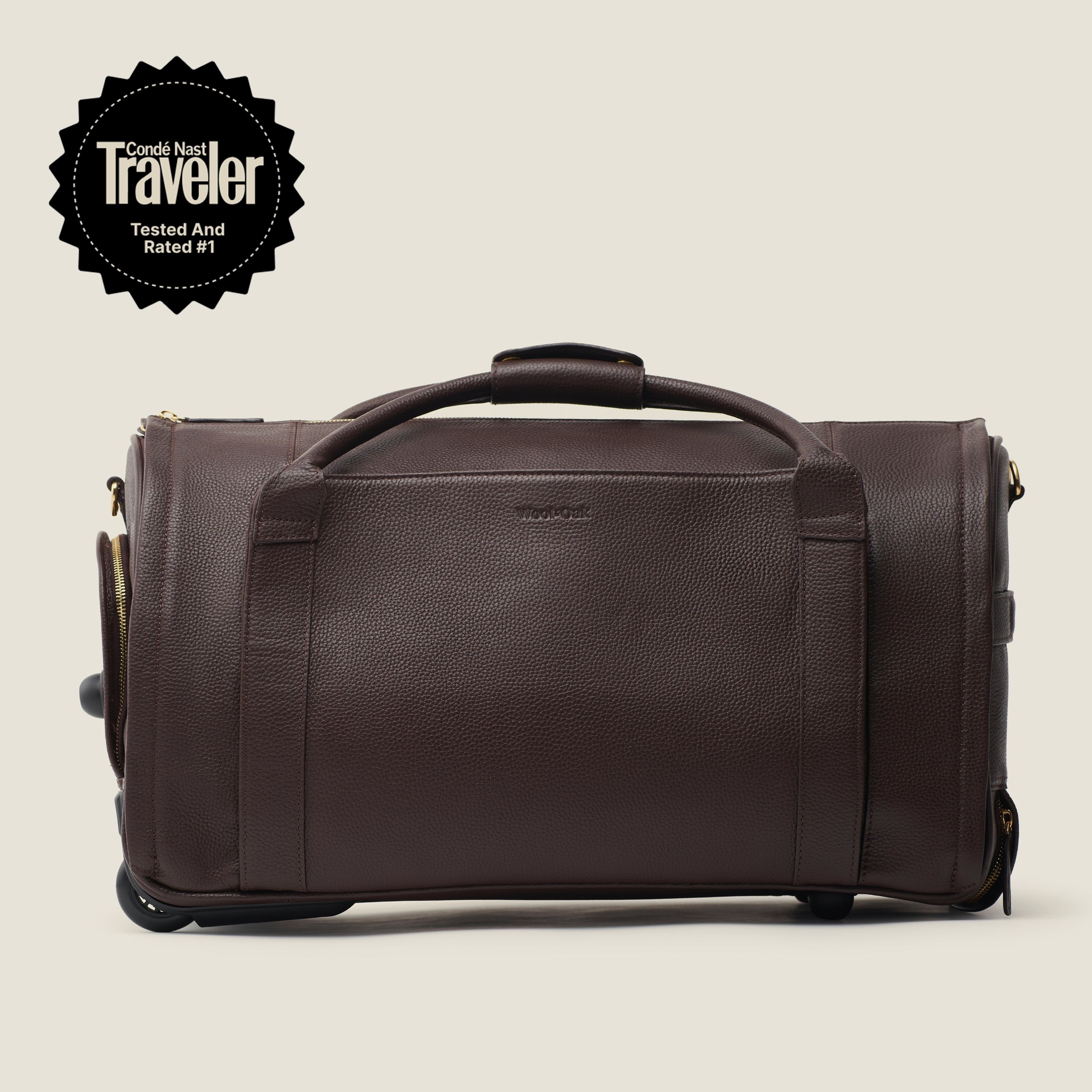
A thoughtfully designed bag takes years of prototyping. At Wool & Oak, the Nova Large went through extensive rounds of testing — adjusting the garment compartment dimensions, refining how the wheels integrate without adding bulk, ensuring the bag meets carry-on requirements across airlines. That's years of iteration before a single bag ships.
Fast-fashion luggage brands release new "collections" every season, chasing trends. The design cycle is weeks, not years. The result works on Instagram. It doesn't necessarily work at the airport. Independent testers at Travel + Leisure and Condé Nast Traveler both tested and awarded the Nova — naming it Best Garment Bag and Best garment-duffel, respectively.
The Cost-Per-Use Math
Price is what you pay. Cost is what you pay over time. Here's the math that changes the conversation:
| Scenario | Purchase Price | Lifespan | Uses (est.) | Cost Per Use | 10-Year Cost |
|---|---|---|---|---|---|
| Full-grain leather bag | $500 | 20+ years | 200+ | $2.50 | $500 |
| Mid-range nylon bag | $150 | 3–4 years | 50–60 | $2.50–$3.00 | $375–$450 |
| Budget bag | $80 | 1–2 years | 15–25 | $3.20–$5.30 | $400–$800 |
The $500 bag and the $150 bag converge on cost-per-use within a few years. But the $500 bag is still going strong at year ten, developing character, while the $150 bag is on its third replacement. The budget bag? You've spent more in total and have nothing to show for it but a pile of landfill contributions.
What Lower-Priced Bags Cut Corners On
Every low price has a reason. Here's where the savings come from in budget luggage:
- Glued seams instead of stitched — faster to produce, first to fail
- Cheap lining fabric that tears at the seams within months
- Plastic hardware painted to look like metal — the plating chips, the clasps snap, the zippers jam
- "Genuine leather" or bonded leather that peels, cracks, and flakes
- No reinforcement at stress points — handles tear away, corners wear through, bases collapse
- Thin, floppy structure that can't hold its shape when half-full
None of these are visible in a product photo. They're only visible after the first trip, the first rainstorm, the first time you actually rely on the bag.
The Patina Argument
Full-grain leather is the only travel material that genuinely gets better with age. This isn't marketing language. It's material science. The natural oils in the leather, combined with handling, sunlight, and moisture, create a surface transformation called patina — a deepening of color and a softening of texture that makes every bag unique to its owner.
Nylon fades. Polycarbonate collects permanent scratches. Bonded leather peels like sunburned skin. Canvas stains. But a full-grain leather bag at year five looks richer, warmer, and more distinguished than it did on the day it arrived. The scratches become character. The darkened handles tell the story of every trip you've taken.
You can't buy patina. You can only earn it. And a simple care routine keeps it looking its best — see our guide on how to care for leather luggage.
Independent vs Corporate: Where Your Money Goes
This is the part most luggage brands don't talk about. When you buy from a venture-capital-backed luggage company, a portion of your purchase price may go toward investor returns, marketing budgets, and the overhead that comes with scaling.
Wool & Oak was founded in NYC by Gizem Mut and Jonathan Webster — husband and wife, still running the company today. Zero outside investment. Bootstrapped from a Kickstarter campaign. Every dollar from a sale goes back into materials, design, production, and taking care of customers directly.
The difference shows up in the numbers. On Trustpilot (as of April 2026), Wool & Oak holds a 4.6-star rating from 345 reviews. Compare that to other brands:
| Brand | Trustpilot Rating | Reviews | Funding |
|---|---|---|---|
| Wool & Oak | 4.6 stars | 345 | Bootstrapped |
| Rimowa | 4.0 stars | 1,705 | LVMH (corporate) |
| Tumi | 1.9 stars | 217 | Samsonite (corporate) |
| Away | 1.7 stars | 921 | $194M+ VC funding (source: Crunchbase) |
Trustpilot ratings sourced from trustpilot.com as of April 2026. Ratings may change. We encourage readers to verify current ratings directly.
These are separate data points worth noting. Wool & Oak, a bootstrapped company, holds the highest satisfaction rating. Away, with $194M+ in venture funding, has a 1.7-star rating. Different business models may lead to different priorities around product quality, customer service, and marketing spend.
At Wool & Oak, the founders answer customer emails. That's not a slogan. It's the actual structure of a two-person company that chose to stay small, stay independent, and stay obsessed with the product. (Read the full Wool & Oak origin story.)
The Bottom Line
A $500 leather bag is not a luxury purchase. It's a refusal to keep replacing things that break. It's a bet on materials that improve instead of degrade, on construction that holds instead of separates, on a company that answers the phone instead of hiding behind a chatbot. The sticker price is higher. The actual cost — measured in years, in replacements avoided, in the quiet satisfaction of owning something that gets better every time you use it — is lower.
That's the math. That's the argument. And that's why, ten years from now, you'll still be carrying the same bag — and it'll look better than the day you bought it.
The Nova Large
Full-grain leather carry-on with garment compartment, wheels & a lifetime of patina ahead of it. Named Best Garment Bag by Travel + Leisure. Best garment-duffel by Condé Nast Traveler.
ShopFrequently Asked Questions
How long do leather bags last?
Full-grain leather bags with quality hardware and stitched construction can last 20 years or more with basic maintenance. Conditioning every two to three months and proper storage between trips are the two most important factors. Many leather bags are passed down between generations.
Is leather luggage worth the investment?
Yes, when measured by cost-per-use over time. A $500 leather bag used over 15 to 20 years costs roughly $2 to $3 per use. A $100 to $150 bag replaced every two to three years costs the same or more per use — and you end up spending more in total over a decade. Leather also develops patina with age, meaning it appreciates aesthetically while synthetic materials degrade.
Why is Wool & Oak cheaper than Tumi?
Wool & Oak is an independent, bootstrapped company with no outside investors and minimal corporate overhead. The brand sells direct to consumers, cutting out retail markups. Tumi is owned by Samsonite and carries the costs of corporate infrastructure, retail store leases, and brand licensing. Wool & Oak puts a higher percentage of the purchase price into materials and construction rather than overhead and investor returns.
What's the difference between a $200 bag and a $500 bag?
The primary differences are material grade, hardware quality, and construction method. A $200 bag typically uses corrected-grain or bonded leather (or nylon), generic zippers, and glued seams. A $500 bag uses full-grain leather, YKK Excella or equivalent zippers, solid brass hardware, and stitched and reinforced seams. The $200 bag will likely need replacing in two to four years. The $500 bag is built to last decades and develops character with age rather than showing wear.
